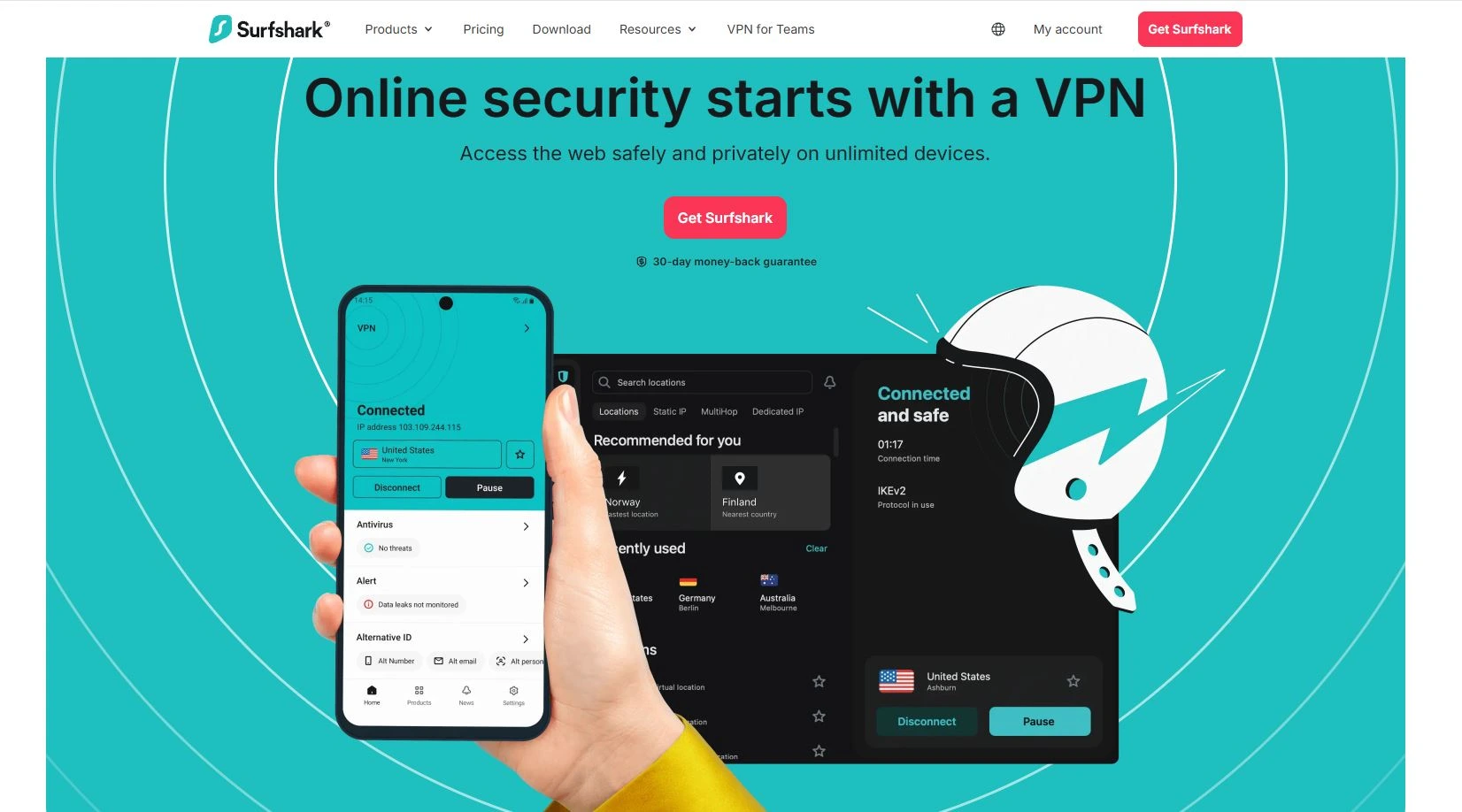

Surfshark
Commission Rate & Model
Surfshark’s affiliate program is primarily a revenue share offer with commissions that start at 40% of revenue on new sales. Surfshark also states it is flexible with custom payouts (and alternative commercial terms such as CPA-style arrangements) for partners with strong performance or high-value traffic.
| Commission element | What Surfshark offers | How it applies in real affiliate reporting |
|---|---|---|
| Base payout type | Revenue share (rev-share) program structure. | Commission is calculated as a percentage of eligible revenue from the referred purchase rather than a fixed bounty by default. |
| Starting commission level | Commissions starting at 40% revenue share on new sales. | The highest-value conversions are typically first-time purchases on longer plans (higher order value → higher commission amount). |
| Eligible products | The affiliate program can cover Surfshark’s full security suite (VPN plus additional security products offered under the brand). | Earnings can increase when referred customers buy bundles or add-on products, not only the standalone VPN plan. |
| Recurring revenue | Surfshark’s affiliate terms state that recurring sales are not paid unless specifically agreed otherwise via the applicable advertising agreement. | The default expectation is commission on the initial “new sale” conversion event; ongoing renewals are not guaranteed under the standard offer unless custom terms are in place. |
| Custom payouts / CPA options | Surfshark states it can offer custom payouts and performance-based terms. In practice, this can include alternative structures like CPA-style agreements. | Publishers with consistent volume, strong conversion rates, or premium traffic sources can sometimes move off the baseline rate into negotiated terms. |
| Adjustments & reversals | The program’s terms allow for adjustments tied to post-sale events (e.g., refunds/chargebacks) and offsetting of amounts where applicable. | Reported commissions can be reduced if a purchase is later refunded or charged back within the brand’s post-purchase policies. |
- 40%+ rev share is above average for many consumer software categories
- VPN plans often sell as long-term subscriptions, increasing the order value per conversion
- Program scope can include the security suite, expanding eligible cart value beyond VPN alone
- Standard program language focuses on new sales (renewals not automatically commissionable)
- Commission amounts can vary significantly by plan length and promotions/discounts
- Refund/chargeback windows can create reversals in affiliate reporting
If a referred customer completes a new purchase and it is eligible under the program terms, the affiliate commission is calculated as 40% of the eligible revenue for that new-sale transaction. Custom terms can change the percentage or switch the structure (e.g., CPA) when agreed.
Cookie Duration
Surfshark lists an affiliate cookie duration of 30 days. Their cookie implementation includes tracking cookies that are explicitly described as indicating the source of the last visit, plus a referral tracking cookie. Practically, this aligns with a last-visit / last-click style overwrite risk inside the cookie window when a user re-enters through another tracked source before purchasing.
| Tracking element | What Surfshark offers | What typically affects attribution |
|---|---|---|
| Cookie duration |
Surfshark’s affiliate program lists a 30-day cookie duration for tracking referred customers.
|
Conversions occurring within the 30-day window are eligible for tracking, but the credited publisher can change if the user clicks other tracked sources before purchase.
|
| Attribution signals |
Surfshark’s cookie set includes cookies described as “landing page tracking” that indicate the source of the last visit, plus a referral cookie used for affiliate attribution.
|
“Last visit” tracking behavior typically means that if a user re-enters the site via another tracked entry (another affiliate, deal aggregator, or other campaign), it can overwrite the original source before checkout.
|
| Session flow and redirects |
Surfshark supports affiliate tracking via its main platform stack (commonly TUNE/HasOffers) and also via major networks, depending on where the affiliate joined.
|
Multiple hops (link shorteners, extra redirects, aggressive interstitials) increase the chance tracking is interrupted on stricter browsers; direct linking and clean landing paths usually preserve attribution better.
|
| Cross-device attribution |
Standard cookie tracking is browser/device based.
|
A click on mobile followed by a purchase on desktop often breaks attribution unless the buyer completes the purchase in the same environment (or tracking is recovered through account/device linking, which should not be assumed as default).
|
| Tracking blockers / privacy |
Modern browsers and privacy tools can limit marketing cookies, shorten retention, or block storage entirely.
|
Users who run strict ad-blockers or anti-tracking settings can reduce tracked conversions; VPN audiences over-index on privacy tools, so this is a real-world attribution constraint.
|
| Invalid/forbidden tracking tactics |
Surfshark’s affiliate terms explicitly prohibit cookie stuffing and other forced-cookie methods.
|
Violations can lead to disqualification of the associated actions/commissions and account-level enforcement, so attribution must be generated via genuine user clicks.
|
- User clicks multiple VPN comparison sites (last-visit overwrite)
- Cross-device buying (cookie not present on purchase device)
- Strict browser privacy / tracking blockers
- Extra redirects or aggressive link wrappers
- Same-session purchase after reading a review/comparison
- Return purchase within 30 days without re-clicking a competitor link
- Single-device flow (mobile → mobile purchase, or desktop → desktop purchase)
- Direct affiliate link paths with minimal hops
A visitor clicks your Surfshark affiliate link on June 1 and purchases on June 20 → within 30 days → eligible for tracking. If the same visitor clicks another tracked Surfshark promotion on June 18 and then purchases, the “last visit” source can receive the credit.
Payouts
Surfshark pays affiliate commissions on a request basis (unless otherwise agreed). The program sets a $100 minimum payout threshold, applies a clearance period aligned with the 30-day money-back guarantee, and then pays commissions based on an invoice (which Surfshark can auto-generate) with payment remitted within 30 days from the invoice.
| Item | What Surfshark offers | What this means in practice |
|---|---|---|
| Payout frequency |
Payouts are made upon request, unless a different arrangement is agreed. Surfshark also states that for partners generating steady revenue,
it can issue an invoice at the beginning of each month without requiring a manual message/request each time.
|
Many affiliates effectively operate on a monthly rhythm (especially if invoicing is automated), but the default is not “fixed weekly/bi-weekly” — it’s request-driven unless customized.
|
| Minimum payout threshold |
Surfshark sets a minimum payable balance of $100. Balances under $100 are stated to roll over month to month until the minimum is reached (unless the agreement ends first).
|
Smaller accounts typically accumulate commissions over time before requesting payout; once above $100, payout can be initiated.
|
| Hold / validation period |
Commissions may be requested only after Surfshark’s 30-day money-back guarantee (or an equivalent end-user cancellation/refund period in effect) has elapsed from the date of the specific qualified action.
|
Sales can appear in reporting earlier, but payout eligibility starts after the clearance window. This reduces reversals tied to refunds.
|
| Invoice & payment timing |
Surfshark can auto-generate an invoice on behalf of the affiliate and states it will remit payment
within thirty (30) days based upon that invoice.
|
After the clearance period + request, payout timing is tied to the invoicing workflow. “Within 30 days of invoice” is the stated settlement window.
|
| Payment method |
Payment is made according to the agreed-upon payment method set in the affiliate’s Surfshark TUNE (HasOffers) account.
|
The available payment options are those enabled for the affiliate inside the Surfshark affiliate platform account (method availability can vary by partner setup).
|
| Costs, offsets & reversals |
Surfshark’s terms state that the affiliate covers costs/expenses related to payment, reserves the right to charge back commissions for actions later found not to meet qualified-action requirements,
and may offset any amounts the affiliate owes Surfshark against amounts payable.
|
Refunds/chargebacks or qualification failures can reduce payable commissions; if overpaid, adjustments can be netted from future payouts.
|
- Commission still within the 30-day clearance period
- Total balance is below $100 (rollover applies)
- Payout request not submitted (for accounts on request-based payout)
- Incorrect or incomplete payment details in the affiliate platform
- Clear published rules on threshold and clearance
- Option for monthly auto-invoicing for steady partners
- Invoice-based settlement gives a defined “within 30 days” payment window
- Qualification/chargeback logic reduces “messy” reporting long-term
A referred customer purchases → the action becomes eligible after the 30-day money-back period → affiliate requests payout (if request-based) → invoice is generated → payment is remitted within 30 days of the invoice, provided the account balance is above $100.


Languages




Target Market
Surfshark positions its affiliate program as worldwide, and explicitly supports promotion in all languages. The product is consumer-focused, with use cases spanning privacy protection, public Wi-Fi security, travel, and geo-restricted content access. As a result, the program’s best target market is not limited to a single region — it’s strongest wherever users already compare VPNs, search for “best VPN” solutions, or respond to security-and-privacy triggers.
- “Best VPN” researchers comparing providers, pricing, and features before buying
- Deal-driven buyers responding to plan discounts and limited-time promotions
- Travelers who connect on hotel/airport/public Wi-Fi and want encrypted browsing
- Remote workers & students wanting safer browsing on shared networks
- Streaming-focused users looking for stable access to geo-restricted catalogs
- Privacy-conscious users wanting less tracking exposure and safer everyday browsing
- SEO comparison pages: “best VPN”, “Surfshark vs [competitor]”, “VPN for [use case]”
- Problem/solution guides: public Wi-Fi security, travel safety, privacy basics
- YouTube + short-form video: setup walkthroughs, performance testing, feature explainers
- Tech newsletters & communities: privacy/security audiences with permission-based messaging
- Coupon/deal hubs only if compliant with program rules (VPN programs often restrict certain incentive formats)
| GEO / audience segment | What demand looks like | Surfshark positioning that fits |
|---|---|---|
| Tier 1 (US/UK/CA/AU + Western Europe) | High VPN awareness and heavy comparison shopping. Users frequently evaluate speed, streaming access, device support, and pricing. | Value-focused plan pricing + feature set (multi-device household use, security suite add-ons) + performance/streaming compatibility messaging. |
| Travel-heavy markets | Strong need for public Wi-Fi protection and reliable access to services while abroad (hotels, airports, cafés). | “Secure travel browsing” + Wi-Fi risk reduction + easy setup across mobile and laptop devices. |
| Geo-restriction / content access audiences | Users seek stable access to catalogs or services that vary by location and want a simple solution. | Practical “how-to” content + clear device setup steps + reliability framing (avoid unrealistic promises; keep claims accurate). |
| Emerging markets (LATAM/SEA/EE/CIS, etc.) | VPN adoption rises with mobile-first usage, public Wi-Fi dependence, and interest in lower-cost subscriptions. | Budget-friendly long-plan offers + mobile usability + privacy/security education content localized to language and device habits. |
| Language-localized audiences | VPN buying decisions are often driven by clarity and trust; local-language content can convert better than English-only pages. | Localized reviews, FAQs, and setup guides (Windows/macOS/iOS/Android) with local examples (travel, Wi-Fi, streaming). |
| Security-suite buyers | Some users prefer a bundled approach (VPN plus additional security products) rather than a single tool. | Promote the “suite” angle (VPN + optional security add-ons) for users who want a broader protection package. |
Worldwide privacy, travel, and streaming-intent audiences shopping for a consumer VPN (promotion supported in all languages), with strongest conversion from comparison/search traffic and security-minded communities.
Affiliate Approval Process
Surfshark affiliate approval is primarily a channel + compliance review. Publishers are expected to provide a reviewable traffic source (site/app/social/channel) and follow strict rules around spam, prohibited ad formats, misleading claims, and prohibited tracking tactics. Surfshark’s program terms also reserve the ability to withhold/reverse commissions and terminate participation for violations (including invalid traffic, forced cookie placement, and prohibited paid search behavior).
Surfshark typically expects at least one identifiable channel for review (website, content hub, social/video channel, app, community, etc.). Approval is risk-based: transparent placements and clear acquisition methods align best with the program’s compliance model.
The program is explicit about prohibited tactics: spam, deceptive claims, forced tracking/cookie placement, and certain ad formats. Paid search is allowed only within defined constraints, including restrictions around trademarks/brand bidding and specified keywords.
Surfshark operates with enforcement language: invalid traffic, manipulation of attribution, or non-compliant advertising can trigger reversals, removal from the program, and loss of unpaid commissions depending on the violation and timing.
| Requirement area | Status in Surfshark program rules | What visitors should know |
|---|---|---|
| Traffic source quality |
Approval depends on having a reviewable channel and traffic that is not automated, misleading, or artificially generated.
|
Channels with clear content, legitimate audiences, and transparent placements align best with the program’s enforcement-first rules.
|
| Email / messaging |
Spam and unsolicited email promotion is prohibited. Email-based promotion is expected to be permission-based (opt-in) and compliant with applicable laws and platform rules.
|
“Cold blast” tactics and forced distribution are treated as disallowed acquisition methods, which can lead to rejected applications or termination.
|
| PPC / paid search |
Paid search is restricted by banned keywords and trademark/brand-bidding rules (including variations/misspellings). The program expects affiliates to avoid restricted terms and prohibited direct-navigation capture tactics.
|
PPC can be compatible, but only under keyword governance. Violations (especially trademark bidding) are a common enforcement trigger in VPN programs.
|
| Pop-ups / pop-unders |
Pop-up/pop-under advertising is generally treated as not permitted by default unless explicitly agreed/approved in writing for the specific affiliate.
|
This is an approval-sensitive channel type: if a publisher’s primary acquisition is pop traffic, it usually requires explicit approval (otherwise it’s not compliant).
|
| Incentives / cashback |
Incentivized promotion (cashback, rebates, “get paid to buy”) is typically restricted unless explicitly approved in writing.
|
Incentive layers can change conversion quality and refund rates, so they are usually treated as “approval required” rather than default allowed.
|
| Cookie stuffing / forced clicks |
Prohibited. The program explicitly disallows cookie stuffing and other forced-cookie attribution tactics.
|
This is a zero-tolerance rule in most affiliate programs; Surfshark’s terms explicitly treat it as a violation that can void commissions.
|
| Misleading claims / deception |
Deceptive, misleading, or false advertising is prohibited (including misrepresentation of offers, features, pricing, or guarantees).
|
VPN buyers often compare security promises; the program expects affiliates to keep claims accurate and consistent with Surfshark’s approved messaging.
|
| Brand/trademark use |
Trademark use is controlled (especially in PPC, domains, and misleading “official” positioning). Affiliates are expected to avoid implying they are Surfshark or an official support channel.
|
Branding misuse (including confusing domains/ads) is one of the fastest ways to lose approval or have commissions reversed.
|
| Black-hat SEO / automation |
Prohibited tactics include black-hat SEO patterns (doorway pages, hidden text, automated comment spam) and automated traffic generation.
|
Surfshark’s rules favor durable, user-facing content and legitimate placements over manipulation of search or forced link injection.
|
- Unverifiable or unclear traffic source (no reviewable placements)
- Spam, unsolicited email, or automated distribution
- Trademark/brand bidding and restricted PPC keyword use
- Pop traffic without explicit written approval
- Cookie stuffing, forced redirects, or attribution manipulation
- Misleading claims or “official-looking” impersonation
- Content-led channel: reviews, comparisons, guides, or a relevant community
- Transparent user journey (click → landing page → Surfshark checkout)
- Non-incentivized by default (unless explicitly approved)
- PPC only within strict keyword/trademark constraints
- Accurate claims and compliant creative usage
Surfshark typically approves affiliates with a reviewable traffic source and enforces strict promotion rules. Spam, cookie stuffing, misleading claims, and certain ad formats are prohibited; PPC is allowed only within trademark/keyword restrictions, and incentives/pop traffic generally require explicit written approval.
Gallery