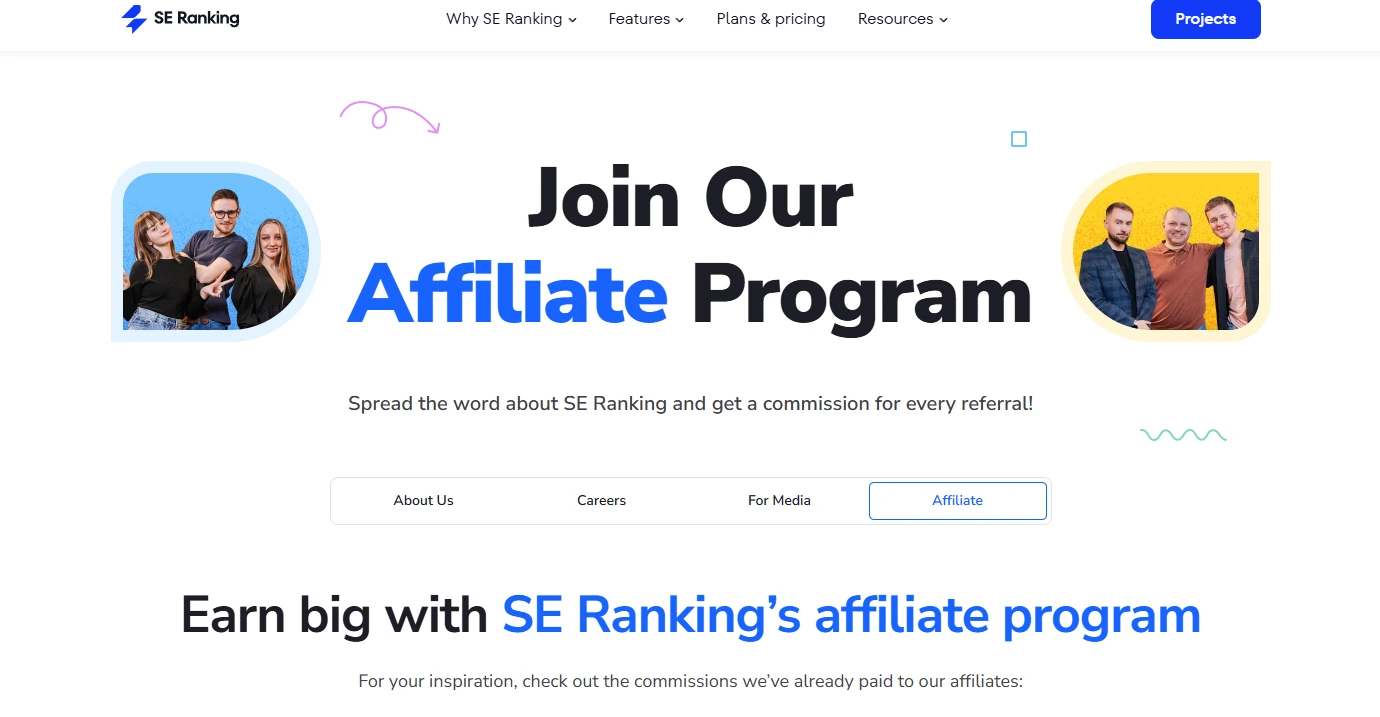

SE Ranking Affiliate Program review
Commission Rate & Model
SE Ranking pays a 30% commission on subscription orders (the program is explicitly positioned for
non-coupon aggregating affiliates). This is a strong, easy-to-understand structure for SEO publishers because it directly aligns
commission with the customer’s subscription purchase.
The key to evaluating “commission structure quality” here is not just the percentage—it’s how reliably you can earn it.
SE Ranking’s commission rules are clean for content affiliates, but the program also draws firm boundaries around certain acquisition styles
(coupon aggregation and specific paid/brand keyword behaviors). If your business model relies on those tactics, your “effective commission”
can drop sharply (or you may not be eligible).
| Component | Exact rule / number | What it means for affiliates (practical) |
|---|---|---|
| Base commission rate | 30% commission | High for SaaS. Strong ROI potential when you rank for comparison terms (“vs”, “best rank tracker”, “pricing”) and convert higher-AOV agency buyers. |
| Commissionable product | Subscription orders | Your earnings correlate with paid subscriptions (not just leads). This generally improves “earnings per click” for high-intent traffic. |
| Audience / publisher type | Designed for non-coupon aggregating affiliates | Great for creators, educators, agencies, and SEO publishers. Not a good fit if you primarily run coupon scraping/aggregation properties. |
| Attribution interaction (commission reality) | Last-click attribution environment (competitive niches often behave like “last touch wins”) | In SEO tools, many affiliates compete for the same buyers. Your commission rate is only valuable if your content is the last meaningful click before purchase. That’s why “pricing”, “review”, and “vs” pages often outperform generic informational content. |
| Paid promotion constraints (impact on commission ability) | Brand keyword and paid-placement restrictions apply | If your growth plan includes PPC, your commission model must be evaluated together with policy. Even with 30%, prohibited campaigns can lead to zero earnings or account issues. This program strongly favors compliant, intent-driven content over aggressive paid bidding. |
| Discount / coupon strategy constraints | Coupon aggregation sites are not eligible to register; coupon-style models are restricted | If you plan to monetize with “coupon intent,” you need a legitimate content angle (e.g., “pricing explained” or “best plan for X”) rather than coupon scraping. |
| Forecasting & unit economics | Simple: Commission = 30% × (subscription order value) | One of the easier SaaS programs to model. Your main variables are conversion rate (intent quality) and average subscription value (buyer type: SMB vs agency). |
| Best-fit content types | Comparisons, pricing breakdowns, workflows, tutorials | These formats attract “ready-to-buy” users and position your click as the final decision step—critical in last-click environments. |
- High rate for SaaS: 30% is meaningfully above average in many software affiliate categories
- Simple to understand: commission ties directly to subscription orders
- Content-friendly positioning: favors review/tutorial publishers who can build trust and educate
- Works with long consideration cycles: pairs well with SEO-tool buyer behavior (research first, buy later)
- Not coupon-ecosystem friendly: coupon aggregation is restricted (can eliminate certain traffic strategies)
- PPC restrictions matter: commission is meaningless if your main channel violates brand keyword / paid placement rules
- Competitive last-click dynamics: you must win the final click—generic “SEO basics” content often won’t
If you want the 30% commission to translate into real income, build assets that capture the final decision stage: “SE Ranking pricing”, “SE Ranking vs [competitor]”, “best rank tracker for agencies”, “SEO audit workflow”, plus a clear recommendation for which plan fits each persona.
Cookie Duration
SEO tools are rarely “buy on first visit” products—agencies and marketers compare options, test features, review pricing, and return later.
SE Ranking’s tracking is built for that reality: it provides a 120-day cookie duration and uses a last-click attribution model.
The practical effect is straightforward: if a user clicks your affiliate link and converts within 120 days, you can be credited—as long as your click is the last tracked affiliate touchpoint before purchase.
This is great for content publishers who can win the final decision stage (pricing pages, “vs” comparisons, and product walkthroughs),
but it also means you can lose attribution if the user clicks another affiliate link later (even from a competitor’s comparison page).
| Tracking element | Exact rule / number | What it means for affiliates (practical) |
|---|---|---|
| Cookie duration | 120 days | Excellent for long buyer journeys. You can publish “educational” content and still monetize users who come back weeks later—provided you’re the last click. |
| Attribution model | Last-click | The final tracked affiliate click before purchase wins. This favors “decision-stage” pages (pricing, comparisons, product demos) more than top-of-funnel articles. |
| Overwrite / competition dynamics | Last click can be overwritten by a later affiliate click within the 120-day window | If a user reads your guide, then later clicks a different affiliate’s “SE Ranking discount” or “SE Ranking vs X” page, you may lose credit. Retaining attribution becomes a “win the final step” game. |
| Cross-device behavior | Cookie tracking is device/browser dependent unless the program supports account-based tracking | If a user clicks on mobile and buys on desktop, cookie-based systems may fail to attribute unless there is a cross-device mechanism. Treat cross-device attribution as “not guaranteed” unless you have explicit confirmation in the dashboard. |
| Cookie blocking / privacy settings | Some users block cookies or clear them regularly | A long cookie window helps only if cookies persist. Expect some attribution loss from privacy settings, browser restrictions, and cookie deletion—especially among tech-savvy audiences. |
| Refunds / chargebacks effect | Commissions typically depend on successful payment and may be reversed for refunds | Most SaaS affiliate programs reserve the right to reverse commissions for refunded/invalid transactions. Model conservatively if you are driving trial-heavy or low-intent traffic. |
| Best content types for last-click | Pricing explainers, comparisons (“vs”), reviews, tutorials | These formats naturally become the last touchpoint before purchase because they answer “Should I buy now?”—which last-click rewards. |
| Worst content types for last-click | Broad informational SEO content with no purchase intent | Great for awareness, weaker for attribution: users often leave to compare elsewhere and your click isn’t the last one. If you do top-of-funnel, include internal pathways to decision-stage pages to reclaim the final click. |
- 120 days is a premium cookie window for SaaS
- Matches real SEO-tool buying behavior (research → compare → buy later)
- Highly monetizable for creators with comparison/pricing content
- Last-click overwrite: competing affiliates can steal credit late in the funnel
- Cross-device leakage: cookie tracking may not follow the user to a different device/browser
- Cookie loss: privacy settings and cookie clearing reduce effective attribution
1) Build a pricing page and a SE Ranking vs competitors page · 2) Use top-of-funnel articles to funnel readers into those decision pages · 3) Add clear CTAs and “best plan for…” recommendations · 4) Use email follow-ups (opt-in) to bring users back and regain last click · 5) Assume some loss from cross-device and cookie blocking—optimize for high-intent traffic to offset it.
Payouts
SE Ranking’s payout setup is designed to be accessible for smaller and mid-sized affiliates. Once you reach the
$50 minimum, payouts are scheduled every 14 days (bi-weekly). After a payout is initiated,
processing can take up to 5 calendar days.
The program supports multiple payout routes: PayPal, Payoneer, and SE Ranking balance.
In practice, the “best” method depends on your country, fees, and whether you want the money in a wallet (PayPal),
a cross-border payout platform (Payoneer), or to keep it inside the ecosystem as balance.
The biggest operational requirement is documentation: affiliates must submit the appropriate tax form
(W-9 for US persons, W-8BEN / W-8BEN-E for non-US). Without these forms, payouts can be blocked,
and commissions can be forfeited after 12 months if the paperwork is not provided (with only limited recovery options).
| Payout element | Exact rule / number | What it means for affiliates (practical) |
|---|---|---|
| Payout frequency | Every 14 days | Faster cashflow than typical “net-30”/monthly SaaS programs. Helpful for creators reinvesting into content, tools, or ads. |
| Minimum payout threshold | $50 | Low minimum makes the program accessible early. You can reach first payout with modest volume if you target high-intent keywords. |
| Processing time | Up to 5 calendar days | Payouts aren’t always “instant.” Plan a small buffer if you need money on a specific date (e.g., to pay contractors or tools). |
| Payment methods | PayPal, Payoneer, SE Ranking balance | You can pick the method that best matches your region and fee sensitivity. Payoneer is often preferred for cross-border payouts; PayPal is convenient; “balance” can be useful if you want to reinvest in the platform. |
| Fees & FX reality | Provider fees may apply depending on method (wallet fees, withdrawal fees, FX conversion spreads) | Your “net received” can be lower than the payout amount if your provider charges fees or converts currencies. If you’re outside USD regions, Payoneer often produces more predictable cross-border outcomes than PayPal, but it depends on your country. |
| Verification / compliance gate | Tax forms required: W-9 (US) or W-8BEN/W-8BEN-E (non-US) | This is the #1 reason affiliates get stuck: you can earn commissions, but payouts can be blocked until forms are submitted and accepted. |
| Forfeiture risk | If required tax documentation is not provided, commissions can be forfeited after 12 months | Don’t “leave it for later.” Submit paperwork right after approval—this rule turns a minor admin task into a high-stakes risk if ignored. |
| Practical payout reliability | Predictable schedule once thresholds and compliance are satisfied | If you hit $50 and have tax forms done, payouts should be straightforward. Most friction comes from missing documentation or payment method setup issues. |
- Fast cadence: every 14 days supports healthy affiliate cashflow
- Low minimum: $50 is beginner-friendly
- Multiple payout routes: PayPal + Payoneer + internal balance
- Clear processing expectation: up to 5 days avoids “where’s my money?” ambiguity
- Tax forms are not optional: payouts can be blocked without them
- Forfeiture rule: commissions can be lost after 12 months if paperwork isn’t provided
- Provider fees/FX: PayPal/Payoneer costs can reduce net received, especially cross-border
1) Set your payout method (PayPal or Payoneer) · 2) Submit the correct tax form (W-9 / W-8BEN / W-8BEN-E) · 3) Test tracking with one controlled click-to-signup path · 4) Keep a “payout buffer” of ~5 days for processing · 5) If you’re cross-border, compare PayPal vs Payoneer fees before choosing.

Languages


Target Market
SE Ranking’s affiliate target market is primarily B2B: people and teams who need SEO software to grow organic traffic, track rankings, run audits,
and report results. Because SEO tools are typically bought after comparison-shopping, the highest conversion rates usually come from
high-intent searchers who already know they need a tool and are evaluating options.
Geographically, SE Ranking is well suited to a global audience because SEO demand exists across nearly every market where businesses compete online.
That said, the strongest affiliate conversion typically comes from regions with high SaaS adoption and willingness to pay for marketing tooling—often
North America, the UK & Ireland, Western Europe, Australia & New Zealand, and established digital hubs in Asia.
Emerging markets can still convert, but often at lower ARPU and with longer decision cycles, depending on pricing sensitivity.
- SEO agencies (small–mid size): need rank tracking, audits, and client reporting at scale; care about margins and efficiency
- Freelancers/consultants: want a capable suite without enterprise pricing; value “all-in-one” convenience
- SMB owners & marketers: need straightforward workflows to compete locally or in niche e-commerce
- In-house marketing teams: require dashboards, collaboration, and consistent reporting for stakeholders
- Content/site operators: publishers and niche site owners optimizing keyword targets and technical health
- Hobby traffic with no budget or business goal (wants “free only” tools)
- One-off needs (users doing a single audit once a year)
- Very large enterprises that require advanced procurement/security workflows (often favor incumbents)
- Coupon-only audiences that buy based purely on discounting (especially if your model relies on coupon aggregation)
| Segment | What they need (pain point) | Affiliate positioning that converts |
|---|---|---|
| Agencies | Multi-client rank tracking + audits + repeatable reporting. Wants cost control and scalable workflows. | “Client-ready reporting and rank tracking workflows” + templates + examples of time saved. Focus on recurring operational value. |
| Freelancers | Needs a full suite to deliver results without paying premium enterprise prices. | “All-in-one toolkit for consultants” + practical demos (audit → fixes → ranking movement). Emphasize value for money. |
| SMBs | Wants predictable steps: find keywords, improve pages, track progress, and measure ROI. | “Beginner-friendly SEO workflows” + checklist content. Reduce overwhelm; show a simple path to results. |
| In-house teams | Needs ongoing monitoring, internal reporting, and accountability to stakeholders. | “Dashboards + consistent reporting” + collaboration angle. Map to KPIs (traffic, rankings, issues resolved). |
| E-commerce operators | Keyword and page optimization for categories/products; tracking competitors; technical site health. | “Ecom SEO playbook” + category targeting + technical cleanup content. Focus on revenue outcomes, not vanity metrics. |
| Publishers / niche sites | Content planning and keyword tracking; maintaining technical health; finding growth opportunities. | “Keyword research → content plan → rank tracking loop” with step-by-step examples; highlight long cookie window benefits for thoughtful buyers. |
| Geographic priority (affiliate view) | Highest-paying and fastest converting regions are typically those with high SaaS willingness-to-pay and mature digital marketing ecosystems. | Prioritize: North America, UK & Ireland, Western Europe, Australia & New Zealand. Expand next into established APAC hubs when you can localize content and pricing expectations. |
| Buyer intent tiers | SEO tools are often bought after research; conversion rates depend heavily on intent. | Highest conversion: “SE Ranking pricing”, “SE Ranking vs [tool]”, “best rank tracker”, “SEO audit tool”. Use comparisons, pricing breakdowns, and workflow demos. |
1) Build content for comparison + pricing intent · 2) Create persona pages (Agency / Freelancer / SMB) · 3) Publish workflow demos (audit → fixes → rank tracking) · 4) Prioritize GEOs with higher SaaS budgets (NA, UK, Western EU, ANZ) · 5) Add “best for” recommendations so users self-qualify before clicking.
Affiliate Approval Process
SE Ranking’s affiliate program is best understood as a quality-controlled SaaS affiliate offer.
If you’re a content publisher, educator, agency, or marketing creator with a real audience, approval is usually straightforward.
If your model is primarily coupon scraping/aggregation or policy-bending paid acquisition, approval risk goes up significantly.
The “approval requirements” can be grouped into three buckets:
(1) publisher legitimacy (who you are + how you drive traffic),
(2) promotional compliance (what you are allowed to do),
and (3) payout compliance (tax documentation before money can be paid out).
Use a live site/channel (blog, YouTube, newsletter, community, agency site) with relevant SEO/marketing content. Applications that don’t clearly show where traffic comes from (or that list generic/empty pages) are the most likely to be delayed or rejected.
The program is positioned for non-coupon aggregating affiliates. If your site is primarily a coupon database/aggregator, you should assume you are not the intended partner type and approval is unlikely.
If you use PPC, you must be able to follow restrictions—especially around bidding on brand keywords and certain paid placements. Approval is easiest for affiliates who rely on content and organic channels rather than aggressive paid bidding.
Even after acceptance, payouts depend on correct tax documentation (W-9 for US; W-8BEN/W-8BEN-E for non-US). Treat this as part of “approval readiness” because missing forms can block payouts and create long-term forfeiture risk.
Approval is not a one-time event. SaaS programs routinely remove affiliates who violate promotional rules, misrepresent offers, or use prohibited traffic sources. Keep your claims accurate and your promotion methods aligned with policy.
| Requirement / check | What the program expects | What it means for affiliates (practical) |
|---|---|---|
| Legitimate publisher presence | Live website/channel with relevant SEO/marketing audience and clear traffic source | Have at least a few strong pieces of content (reviews, comparisons, tutorials). If you’re an agency, show services/case studies and how you’ll promote. |
| Non-coupon aggregator positioning | Program is built for non-coupon aggregating affiliates | Coupon databases/scrapers are a weak fit. If you do “discount intent,” position it as pricing education and plan selection—not coupon scraping. |
| Paid promotion restrictions | Paid ads are restricted; certain ad network behaviors may require explicit permission | If PPC is your main channel, confirm what’s allowed before applying or scaling. Approval and longevity are easier with organic + content-led promotion. |
| Brand keyword rule | Brand keywords are not allowed | Don’t bid on “SE Ranking” and close variants. If you rely on competitor conquesting, ensure it doesn’t drift into brand misuse. |
| Content accuracy / non-deceptive marketing | No misleading claims, fake scarcity, or misrepresentation of pricing/discounts | Keep pricing and discount claims precise and current. In SaaS, inaccurate promo claims are a common reason for reversals and termination. |
| Proper affiliate disclosure | Clear disclosure that affiliate links may generate commission | Add disclosure near CTAs and in footers. This reduces compliance risk and improves audience trust. |
| Tax documentation (payout gate) | W-9 (US) or W-8BEN/W-8BEN-E (non-US) required | Approval may be granted without this, but you should treat it as mandatory onboarding. Without it, payouts can be blocked and long-term forfeiture risk exists. |
| Right to reject / terminate | Program can reject applicants or terminate affiliates that violate rules | Standard SaaS practice: follow the rules and keep proof of compliance for paid campaigns. |
- SEO/marketing blogs with real tutorials, comparisons, and tool reviews
- YouTube educators demonstrating SEO workflows and tool usage
- Agencies with credible services + content strategy (even if traffic is smaller)
- Newsletters and communities with opt-in audiences interested in SEO tooling
- Coupon aggregation or “discount-only” models without real content value
- Unclear traffic sources, empty sites, or applications without a real channel
- PPC strategies that rely on brand keyword bidding or ambiguous ad placements
- Missing tax documentation (can block payouts even after acceptance)
1) Apply with a live site/channel and explain your traffic sources clearly · 2) Show SEO/marketing relevance (reviews, comparisons, tutorials) · 3) Avoid coupon aggregation positioning · 4) If you run ads, confirm you can comply with brand keyword + paid placement rules · 5) Set payout method and submit W-9/W-8 forms immediately after acceptance.
Gallery