HelpDesk
Commission Rate & Model
HelpDesk’s affiliate commission is best understood as a portfolio-level recurring revenue model, not a standalone HelpDesk-only payout chart. Text’s official partner materials say affiliates start at 20% recurring commission for life on each paying subscription they refer, and once they bring in 5 paying customers, the rate increases to 22% for all new licenses. The HelpDesk-specific partner page confirms that HelpDesk is included under that same structure and can earn affiliates up to 22%.
| Commission type | Rate / structure | How this tier behaves |
|---|---|---|
| Starting recurring tier | 20% | New affiliates start on a 20% lifetime recurring commission for paying subscriptions they bring through their affiliate link. This applies across the Text affiliate portfolio, including HelpDesk. |
| Performance tier | 22% | Once you bring in 5 paying customers, your commission rate rises to 22% for all new licenses. Public materials do not say that old licenses are retroactively repriced upward. |
| Payment basis | Revenue share | This is not a fixed CPA. Your payout depends on what the HelpDesk customer actually buys: plan type, number of paid users, billing cadence, and how long the subscription stays active. |
| Billing-cycle effect | Monthly or annual | Text says if the customer pays monthly, you earn month by month; if the customer pays annually, you are paid annually. That makes cash flow timing different even when lifetime value is strong. |
| Second-tier referrals | Exists, but public rate unclear | The Partner app includes a Second Tier link, and Text’s terms define a second-tier model for referring other partners, but the official public pages reviewed did not clearly publish a fixed second-tier percentage or amount. |
- Recurring for life: one successful HelpDesk referral can keep paying as long as the account stays subscribed
- Simple tiering: the core jump from 20% to 22% is easy to understand
- Works well with SaaS retention: recurring B2B support tools can stay active for years
- Scales with account size: more users and higher plans directly increase affiliate earnings
- No HelpDesk-only custom table: payouts are governed by the broader Text affiliate framework
- 22% is not immediate: you need 5 paying customers before new licenses move to the higher tier
- No public second-tier rate: the mechanism exists, but its payout is not clearly disclosed in the sources reviewed
- Revenue-share timing varies: annual subscriptions may pay in bigger but less frequent chunks
If you refer a HelpDesk customer on the Team plan with 5 paid users billed annually, the public price is 5 × $29 × 12 = $1,740 per year. At the starting affiliate rate, that would equal 20% = $348 per year. If you have already crossed the higher tier for new licenses, the same annual account would produce 22% = $382.80 per year.
If the same customer paid monthly instead at 5 × $34 = $170 per month, the affiliate earnings would be $34/month at 20% or $37.40/month at 22%.
Cookie Duration
HelpDesk uses the Text Affiliate Program’s tracking rules, and those rules are clearly published. Text states that each affiliate link includes a 120-day cookie, and the legal terms explicitly say the program operates under a Last Click Attribution Model. In practical terms, that means a referred prospect can take up to four months to create a subscription and still remain attributable, but if that same prospect clicks another affiliate’s referral link later, the last referring affiliate receives the commission credit.
| Tracking element | What Text / HelpDesk offers | What it means for attribution |
|---|---|---|
| Cookie duration | 120 days from the referral click. | This is a long B2B SaaS window, giving prospects time to evaluate HelpDesk, involve teammates, trial the product, and still remain eligible for affiliate credit. |
| Attribution model | Explicit Last Click Attribution Model. | If a prospect clicks multiple affiliate links before converting, the most recent affiliate click gets the referral fee. |
| Tracked conversion step | The referred user must create a subscription within the 120-day cookie window. | A click by itself is not enough. The lead must actually enter the subscription/signup flow during the valid cookie period. |
| Commission eligibility overlay | The referred user must later become a paying client. | A trial or free signup can be tracked, but referral fees depend on that account converting into paid status. |
| Company control over eligibility | The terms say Text retains control over purchase processing, pricing, and referral-fee eligibility. | Even when the referral path is clear, final commissionability is still determined by the company’s system and eligibility rules. |
| Cross-device / special-case tracking | The public affiliate materials reviewed do not clearly publish special cross-device attribution rules. | The official strengths are the 120-day window and last-click clarity; advanced edge cases are less explicitly documented in the public sources reviewed. |
- Long decision window: 120 days is well suited to B2B software buying cycles
- Clear legal attribution rule: last-click is explicitly stated, not implied
- Good fit for content funnels: reviews, comparisons, and tutorials can mature over weeks before a buyer subscribes
- Works with trial-led SaaS behavior: a lead can sign up first and become paid later
- Another affiliate gets the last click before the user subscribes
- The user waits beyond 120 days to create the subscription
- The account never becomes paid, so no referral fee is triggered
- Edge cases are decided by company eligibility rules rather than the affiliate’s own analytics
A visitor clicks your HelpDesk referral link on April 1. If they create a subscription on July 15, that is still within the 120-day cookie window. If they later become a paying client, the referral can be credited to you.
But if that same visitor clicks another affiliate’s HelpDesk/Text link on July 10 before subscribing, the program’s last-click model means the later affiliate would receive the referral fee instead.
Payouts
HelpDesk’s payout process is handled through the broader Text Affiliate Program, and the strongest public source here is the official affiliate page itself. That page says affiliates can request withdrawals directly in the Partner App, that the minimum withdrawal amount is $50, and that payments are made via PayPal’s eChecks. It also explains that commission is earned on every customer payment for as long as the referred subscription stays active, so if the customer is billed monthly, the affiliate earns monthly; if the customer is billed annually, the affiliate earns annually. :contentReference[oaicite:0]{index=0}
| Payout element | What Text / HelpDesk offers | What this means in practice |
|---|---|---|
| Who pays you | HelpDesk affiliate payouts are handled through the Text Partner App, not a separate HelpDesk-only payout portal. | Earnings, withdrawals, and tracking are managed inside the same partner environment used for the wider Text product portfolio. :contentReference[oaicite:1]{index=1} |
| Withdrawal minimum | The official affiliate page states a $50 minimum amount for withdrawal. | This is relatively affiliate-friendly for SaaS. Smaller partners do not need to wait for a very high balance before cashing out. :contentReference[oaicite:2]{index=2} |
| Payment method | The affiliate page explicitly says payments are made via PayPal’s eChecks. | PayPal is the clearest officially documented payout route for affiliates, and you need to add your PayPal details before withdrawing earnings. :contentReference[oaicite:3]{index=3} |
| How you trigger payout | Withdrawals can be requested directly in the Partner App. | The payout flow appears request-based from inside the dashboard, rather than relying on a separate invoicing process for ordinary affiliate withdrawals. :contentReference[oaicite:4]{index=4} |
| Payout cadence of commissions | Text says commission is earned on every payment made by the referred customer; if the customer pays monthly, you earn monthly, and if they pay annually, you earn annually. | HelpDesk affiliate revenue timing mirrors customer billing behavior. Annual subscriptions can create larger but less frequent commission events. :contentReference[oaicite:5]{index=5} |
| Public clarity on bank transfer | Some company blog content mentions PayPal or bank transfer, but the clearest official affiliate-page payout instruction reviewed is PayPal eChecks. | The safest review position is that PayPal is the explicitly documented affiliate withdrawal method. Bank transfer may exist in broader partner discussions, but it is less clearly documented on the core affiliate payout page reviewed. :contentReference[oaicite:6]{index=6} |
| Fixed payout day | I did not find a clearly published official “paid on the 15th” or similar fixed calendar payout date in the core sources reviewed. | The program is clear on withdrawal threshold and method, but less explicit publicly on a hard payout calendar. That slightly reduces transparency compared with programs that publish an exact pay date. :contentReference[oaicite:7]{index=7} |
- Low withdrawal floor: $50 is easier to reach than many SaaS programs
- Clear official method: PayPal eChecks are explicitly documented
- Dashboard-based withdrawal flow: request payouts inside the Partner App
- Recurring payout base: you keep earning while the customer stays subscribed
- No clearly published fixed payout date in the main official sources reviewed
- PayPal dependence: affiliates need a working PayPal setup for the clearly documented route
- Annual billing delays cash timing: larger commissions may arrive less frequently
- Bank transfer is mentioned in blog content, but not as clearly as PayPal on the core affiliate payout page
Suppose your HelpDesk referrals have generated $64 in approved withdrawable earnings. Because the official withdrawal minimum is $50, you can request a payout in the Partner App. If your referred customer is on monthly billing, new commission keeps adding monthly; if that customer switches to annual billing, future affiliate earnings follow that annual payment rhythm instead. :contentReference[oaicite:8]{index=8}

Languages

Target Market
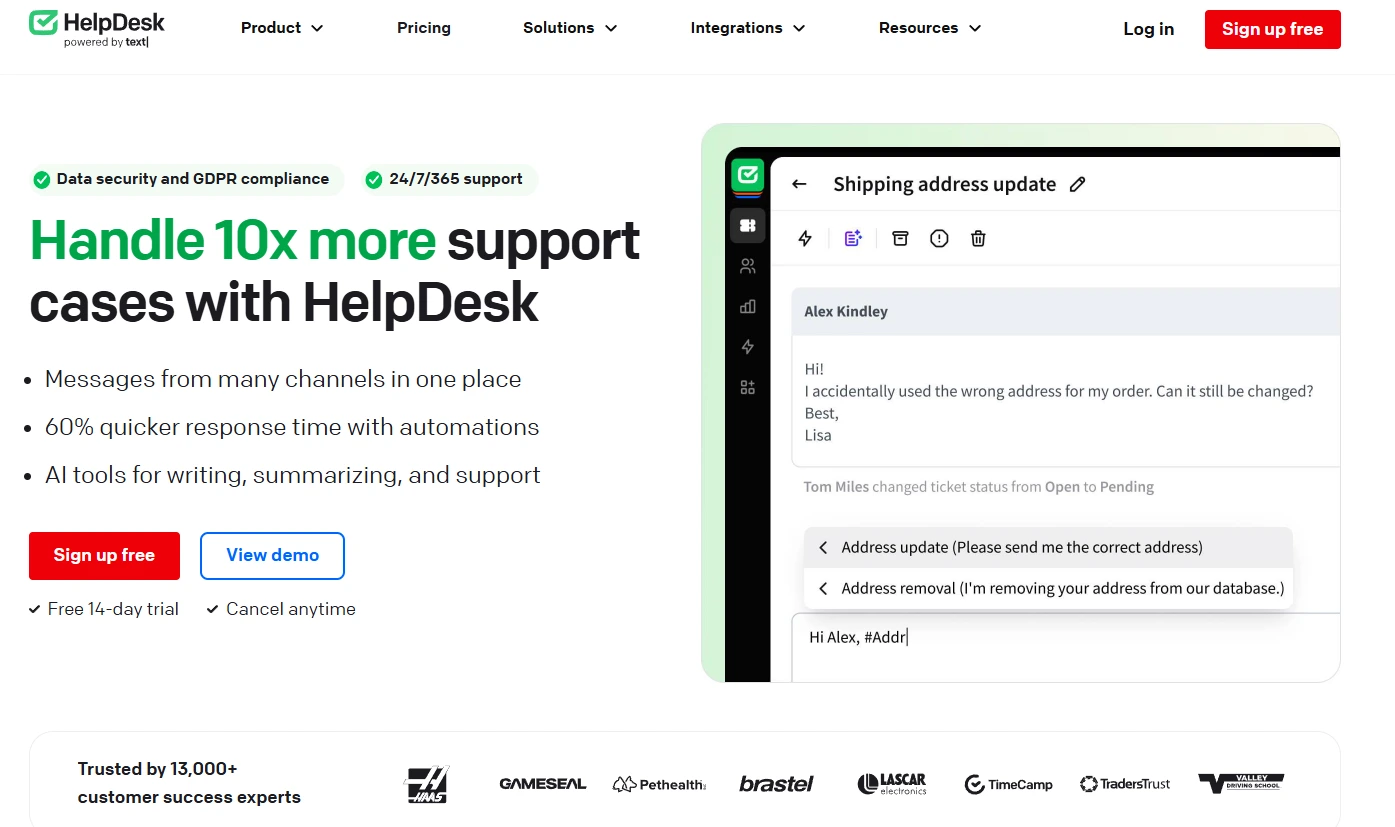
HelpDesk targets a broad but clearly support-centered B2B audience. Its core positioning is not “all-in-one business software,” but a browser-based ticketing system that helps teams organize customer messages, automate repetitive work, collaborate internally, and track service performance. The product is especially well matched to companies that already receive meaningful support volume through email, forms, chat, or other inbound channels and need a structured shared inbox / ticket workflow rather than ad hoc communication.
- Small business support teams that need affordable structure, automations, and clearer ownership of incoming customer messages
- Growing customer service teams moving from basic email inboxes to a dedicated ticketing workflow
- SaaS companies handling product questions, onboarding issues, and account support across multiple channels
- Sales + customer service teams that want buyer communication, support follow-up, and CRM-linked workflows in one place
- IT help desks needing multi-tier support handling for technical requests and internal or external issue tracking
- Enterprise teams that need stronger security, data protection, and a more customizable deployment scope
- “Best help desk software” or “best ticketing system” searches from teams actively evaluating tools
- Shared inbox replacement intent from companies outgrowing support@ email workflows
- Support automation intent around routing, macros, canned responses, and workload reduction
- Small business support-stack intent where price transparency and simplicity matter
- SaaS support operations intent from teams needing organized customer issue handling and integrations
- IT service / internal support intent for teams formalizing ticket handling and escalation
| Audience segment | Typical needs / buying trigger | How HelpDesk is usually positioned |
|---|---|---|
| Small businesses | Need a straightforward support system that is affordable, easy to learn, and capable of organizing customer inquiries without heavy setup. | As a cost-effective, scalable ticketing system for developing companies and resource-limited teams. |
| Growing support teams | Incoming message volume is increasing, team collaboration is becoming messy, and managers need reporting, automation, and clearer ticket ownership. | As a shared, automation-driven support workspace that improves productivity and response consistency. |
| SaaS companies | Need to manage software-related questions, onboarding issues, customer communication across channels, and recurring support operations at scale. | As a support operations hub for software businesses that want better user experience and organized multichannel issue handling. |
| Sales + customer service teams | Want faster responses to buyer questions, better follow-up handling, and easier coordination with CRM or revenue-facing workflows. | As a sales-support bridge that improves buyer service, response speed, and centralized communication handling. |
| IT help desk teams | Need structured handling of technical issues, prioritization, routing, and multi-level support coordination. | As a robust multi-tier IT help desk environment for managing technical queries from simple to complex. |
| Enterprise organizations | Require stronger security controls, AI-supported workflows, and a platform that can align with higher corporate standards. | As an enterprise-grade support platform with security, data protection, and tailored deployment options. |
HelpDesk is best matched to organizations that already have enough inbound customer or support communication to justify a real ticketing workflow. Its strongest audience is not ultra-technical DevOps teams or ultra-light solo email users, but small-to-mid-sized support operations, SaaS companies, IT support teams, and service organizations that want a cleaner, more scalable system for handling incoming requests.
Affiliate Approval Process
HelpDesk does not appear to use a highly restrictive “manual vetting first” affiliate gate. Instead, it sits inside the broader Text Partner Program, which presents the Affiliate program as easy to join through a quick registration flow. That said, the legal framework still gives Text broad discretion to refuse participation and to remove partners later for compliance violations. In other words, getting in looks relatively easy, but staying in depends on following the rules.
Text describes joining the Affiliate program as a quick registration process that gives you access to the Partner app, where you can obtain your referral link and start promoting.
The official terms require the partner to be at least 18 years old, have legal capacity to enter a binding agreement, and — if joining for a company — be authorized to bind that entity.
Text can refuse participation at any time in its sole discretion, and it can suspend or terminate partners for false registration data, policy violations, illegal or harmful use, or attempts to artificially inflate referral fees.
| Promotion method / behavior | Status | What the policy requires |
|---|---|---|
| Content sites, comparison pages, influencer promotion | Allowed | The affiliate page actively positions the program for bloggers, SaaS reviewers, marketers, PPC agencies, and influencers, so standard content-led promotion is clearly welcome. |
| PPC / paid advertising | Allowed | The affiliate page says paid advertising is allowed and says there are no restricted brand keywords, but all placements still need to comply with the partner terms. |
| Referral links on websites / ad placements | Allowed | The terms explicitly allow affiliates to post referral links and register with search, referral, or advertising services, provided each site or placement complies with the agreement. |
| Confusingly similar domains | Not allowed | Partners may not register, use, or attempt to register domains identical or confusingly similar to Text, HelpDesk, or other company brand elements. |
| Objectionable or infringing search terms | Not allowed | The terms prohibit purchasing or registering keywords and search terms that the company deems tied to sexually explicit material, violence, weapons, illegal activity, counterfeit goods, gambling/betting, discrimination, or third-party IP infringement. |
| Spyware, adware, intrusive overlays | Not allowed | Partners may not install spyware/adware or use software, scripts, browser extensions, or overlays that obscure paid ads or interfere with third-party sites. |
| Misleading brand use | Not allowed | Licensed materials cannot be modified, displayed in a misleading way, or used to imply company endorsement outside normal participation in the program. |
| False registration data / artificial fee inflation | Termination-level violation | The terms say false information during registration or attempts to artificially inflate referral fees can lead to immediate termination and forfeiture of outstanding fees. |
- Providing false information during registration
- Using confusingly similar brand domains
- Running prohibited or harmful search placements
- Using spyware, adware, browser overlays, or similar forced-attribution tactics
- Trying to artificially inflate referral fees
- Using licensed materials in a misleading way or implying endorsement
- A legitimate registrant who is 18+ and legally able to contract
- Authority to apply on behalf of a business when relevant
- Promotion through compliant websites, content, or ad placements
- Respect for brand usage rules and domain restrictions
- A verified PayPal account in good standing for withdrawals
This is not a high-friction affiliate application in the style of tightly gated finance or gambling programs. The friction is lighter at entry, but the company keeps broad discretion to refuse participation and stronger powers to suspend, terminate, and withhold outstanding amounts when the rules are breached.
Gallery